Our Three Step Process
October 9, 2026
Funnel Creation, Repair & Revenue Systems: A Practical Guide
Our Three Step Process
October 9, 2026
Funnel Creation, Repair & Revenue Systems: A Practical Guide
Understand the complete journey from awareness to purchase, diagnose funnel leaks, and connect pages, CRM and follow-up. A practical guide by Maris Spalins, founder of Winyourclients.
By Maris Spalins, founder of Winyourclients and author of The $100M Funnel Playbook. Published 9 October 2026.
What is a complete marketing funnel?
A complete marketing funnel is the customer journey from first awareness to purchase. It connects the audience, offer, advertising, website or landing page, enquiry or checkout, and follow-up. The systems behind the funnel manage information, ownership and next actions so the journey can operate consistently.
A funnel is a model of that journey, not a claim that every buyer follows a straight line. Someone may compare options, leave, return through another channel and ask a question before buying. The design should accommodate those paths rather than force everyone through an identical sequence.
What is the difference between a funnel, a landing page and a CRM?
Element | Purpose | Example |
|---|---|---|
Complete funnel | Connects the stages from discovery to purchase. | An advert leads to a relevant page, an enquiry, a consultation and an agreed purchase. |
Landing page | Helps a visitor understand an offer and take a specific next step. | A page explains a service and invites a suitable visitor to request an assessment. |
CRM and follow-up systems | Manage records, responsibility, progress and communication. | An enquiry receives an owner, a stage and a scheduled next action. |
A landing page can perform its role well while the wider journey fails. The form might work, but the enquiry may reach the wrong inbox, lack an owner or receive no response. Equally, an organised CRM cannot resolve an unclear offer or an advert aimed at the wrong audience.
Should you build a new funnel or repair an existing one?
Build a new funnel when the business lacks a coherent journey for a defined audience and offer. Repair an existing funnel when useful assets already exist but customers encounter identifiable gaps. Start by mapping the current journey and checking its evidence before deciding which pages, campaigns or workflows need replacement.
Build: the offer is new, the audience or business model has changed, or the essential journey is missing.
Repair: targeting, messaging, pages, forms, booking, checkout or follow-up contain specific points of friction.
Install systems: suitable demand exists, but records, ownership, handovers and reporting do not support a consistent next step.
These are project choices, not competing services. A repair may require a new landing page and better follow-up. A new funnel may reuse an existing website and CRM.
How do you diagnose where a funnel is leaking?
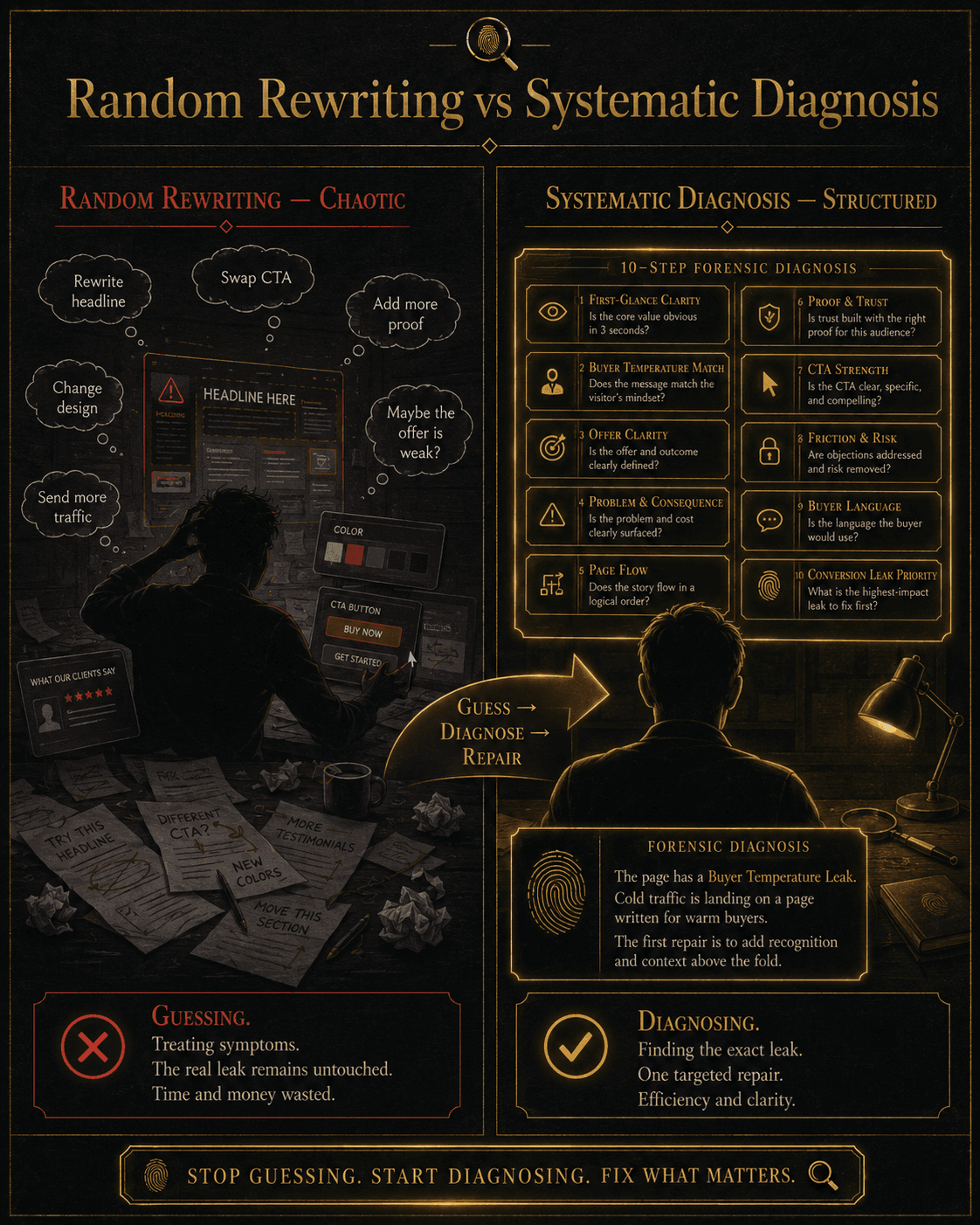
To diagnose a funnel leak, define the stages, check whether the records are reliable, and compare progression between stages for the same cohort and period. Combine those counts with page reviews, customer feedback and sample enquiry histories. A drop-off identifies where to investigate; it does not establish the cause by itself.
Map the actual path. List entry channels, pages, forms, communications, booking or checkout, and the purchase decision.
Define each stage. Specify what qualifies as a visit, enquiry, suitable opportunity, attended appointment or completed purchase.
Check the handovers. Follow a sample record from its source through capture, assignment, response and outcome. Record missing fields and unowned next actions.
Compare comparable groups. Keep stage definitions, time windows and counting units consistent. Separate important differences such as channel or device where the evidence supports it.
Inspect the experience. Read the advert and page together, test the form or checkout, and examine the response a customer receives.
Prioritise and validate a repair. Agree the suspected cause, change, owner and measure. Check the journey again after implementation.
Google Analytics provides funnel exploration for examining defined steps in website or app journeys. Open and closed funnels count entry differently, so the chosen report definition matters. Website analytics and CRM records describe different parts of the journey; they should not be treated as interchangeable evidence.
What should happen after someone submits an enquiry?
After an enquiry, the business should retain the relevant context, assign responsibility, assess suitability and provide a clear next step. Follow-up and booking rules should reflect the offer and the customer's readiness. Reporting should make the record's status, owner and outcome visible, with a route for exceptions requiring human judgement.
For example, a service enquiry may need qualification and a consultation, while an ecommerce customer may proceed directly to checkout. A follow-up workflow should support that business model. It should not add unnecessary calls or steps to a purchase that can already be completed.
HubSpot documents lifecycle stages for representing progress through marketing and sales, and workflow-based owner assignment. Available actions depend on the product and subscription. The operating rules should be agreed before choosing the automation.
Which measures help evaluate a funnel repair?
Stage progression: how many comparable entrants reach the defined next stage?
Enquiry quality: how many enquiries meet the agreed suitability criteria?
Response and ownership: are relevant enquiries assigned and handled within the team's agreed standard?
Booking and attendance: where an appointment is required, do suitable customers book and attend?
Purchase and commercial contribution: what sales result, and how do acquisition and delivery costs affect their value?
Illustrative calculation, not a client result: if 100 enquiries from one defined cohort produce 20 attended consultations within the agreed observation window, enquiry-to-attended-consultation progression is 20%. That figure needs context: customer fit, buying cycle, cancellations and the quality of the underlying records can change its interpretation.
Higher conversion does not automatically mean higher profit. A repair can increase sales while acquisition, discounts, fulfilment or service costs rise too. Review the relevant costs and quality measures alongside conversion rather than treating additional revenue as additional profit.
What does Winyourclients build and install?
Winyourclients builds complete funnels, repairs gaps in existing customer journeys, and installs the marketing, sales and support systems behind them. Depending on the agreed scope, work can include audience research, offers, advertising, conversion copy, websites, landing pages, CRM routing, follow-up, booking and reporting. Paid implementation is scoped separately from the free initial assessment.
Explore funnel creation and repair, sales and follow-up systems, or customer support systems. These services apply across business models; the journey and delivery scope depend on the business.
Where should you start in the resource library?
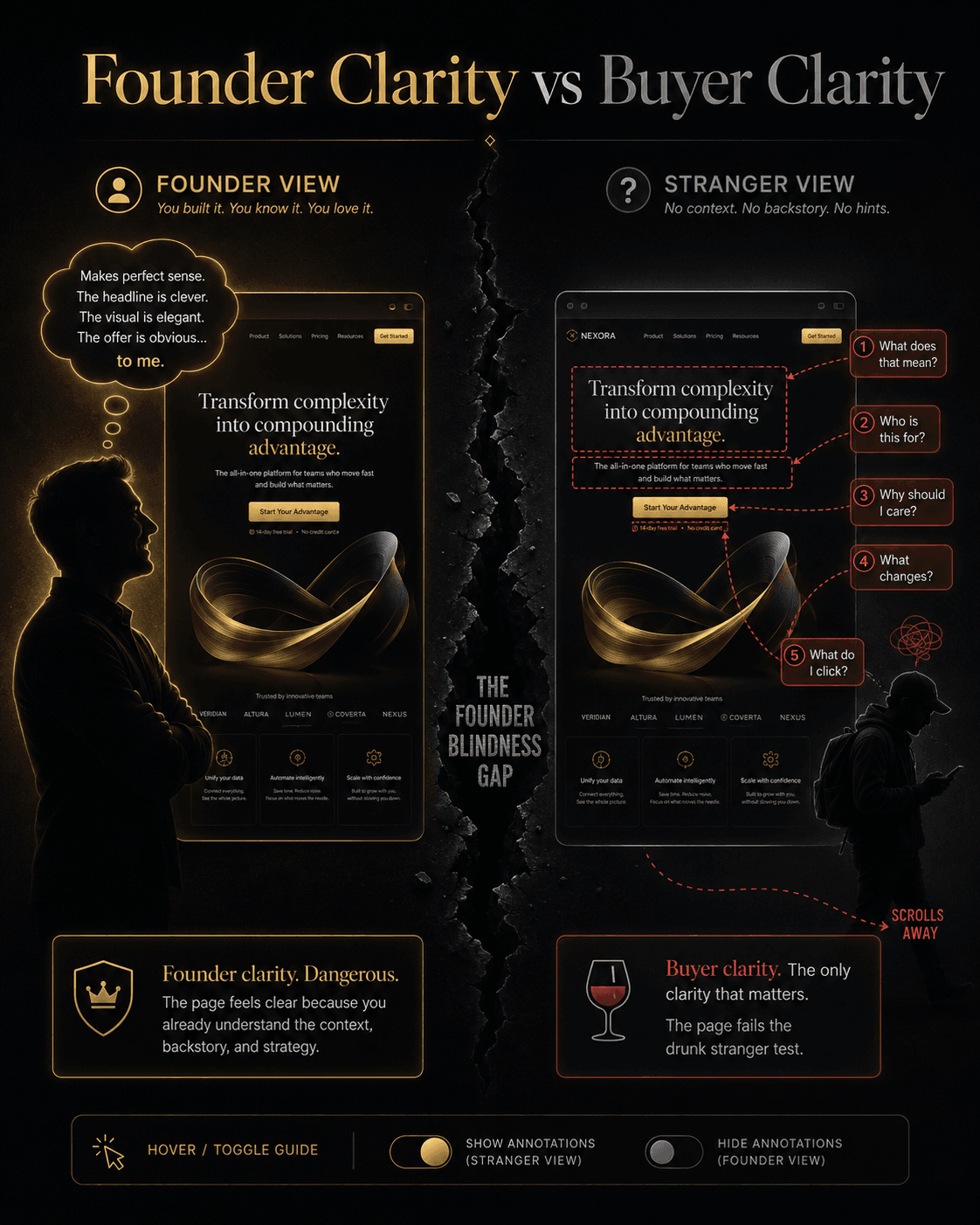
Page clarity: use the Drunk Stranger Framework to examine whether a visitor can understand the page.
Journey diagnosis: use the Funnel Autopsy Worksheet to examine the stages and points of friction.
Lead progression: read Cold, Warm, Hot: Routing Rules That Stop Revenue Leaks.
Automation boundaries: read Human-in-the-Loop Automation Governance.
The example client journeys show possible project scopes. They are illustrative examples, not completed engagements or verified client results.
How does the free initial assessment work?
The free initial assessment helps Winyourclients understand your business, current journey and whether there is a fit. It precedes any separately agreed paid work. To begin, apply for a diagnosis with a description of the issues you want assessed.
Sources and method
The diagnostic sequence and service explanations in this guide describe Winyourclients' approach. They are not a controlled study or a promise of a particular conversion or revenue uplift. The linked Google Analytics and HubSpot documentation supports the specific reporting and CRM capabilities discussed. Sources checked on 9 October 2026.
About Maris Spalins and Winyourclients · Browse the complete resource library
Understand the complete journey from awareness to purchase, diagnose funnel leaks, and connect pages, CRM and follow-up. A practical guide by Maris Spalins, founder of Winyourclients.
By Maris Spalins, founder of Winyourclients and author of The $100M Funnel Playbook. Published 9 October 2026.
What is a complete marketing funnel?
A complete marketing funnel is the customer journey from first awareness to purchase. It connects the audience, offer, advertising, website or landing page, enquiry or checkout, and follow-up. The systems behind the funnel manage information, ownership and next actions so the journey can operate consistently.
A funnel is a model of that journey, not a claim that every buyer follows a straight line. Someone may compare options, leave, return through another channel and ask a question before buying. The design should accommodate those paths rather than force everyone through an identical sequence.
What is the difference between a funnel, a landing page and a CRM?
Element | Purpose | Example |
|---|---|---|
Complete funnel | Connects the stages from discovery to purchase. | An advert leads to a relevant page, an enquiry, a consultation and an agreed purchase. |
Landing page | Helps a visitor understand an offer and take a specific next step. | A page explains a service and invites a suitable visitor to request an assessment. |
CRM and follow-up systems | Manage records, responsibility, progress and communication. | An enquiry receives an owner, a stage and a scheduled next action. |
A landing page can perform its role well while the wider journey fails. The form might work, but the enquiry may reach the wrong inbox, lack an owner or receive no response. Equally, an organised CRM cannot resolve an unclear offer or an advert aimed at the wrong audience.
Should you build a new funnel or repair an existing one?
Build a new funnel when the business lacks a coherent journey for a defined audience and offer. Repair an existing funnel when useful assets already exist but customers encounter identifiable gaps. Start by mapping the current journey and checking its evidence before deciding which pages, campaigns or workflows need replacement.
Build: the offer is new, the audience or business model has changed, or the essential journey is missing.
Repair: targeting, messaging, pages, forms, booking, checkout or follow-up contain specific points of friction.
Install systems: suitable demand exists, but records, ownership, handovers and reporting do not support a consistent next step.
These are project choices, not competing services. A repair may require a new landing page and better follow-up. A new funnel may reuse an existing website and CRM.
How do you diagnose where a funnel is leaking?
To diagnose a funnel leak, define the stages, check whether the records are reliable, and compare progression between stages for the same cohort and period. Combine those counts with page reviews, customer feedback and sample enquiry histories. A drop-off identifies where to investigate; it does not establish the cause by itself.
Map the actual path. List entry channels, pages, forms, communications, booking or checkout, and the purchase decision.
Define each stage. Specify what qualifies as a visit, enquiry, suitable opportunity, attended appointment or completed purchase.
Check the handovers. Follow a sample record from its source through capture, assignment, response and outcome. Record missing fields and unowned next actions.
Compare comparable groups. Keep stage definitions, time windows and counting units consistent. Separate important differences such as channel or device where the evidence supports it.
Inspect the experience. Read the advert and page together, test the form or checkout, and examine the response a customer receives.
Prioritise and validate a repair. Agree the suspected cause, change, owner and measure. Check the journey again after implementation.
Google Analytics provides funnel exploration for examining defined steps in website or app journeys. Open and closed funnels count entry differently, so the chosen report definition matters. Website analytics and CRM records describe different parts of the journey; they should not be treated as interchangeable evidence.
What should happen after someone submits an enquiry?
After an enquiry, the business should retain the relevant context, assign responsibility, assess suitability and provide a clear next step. Follow-up and booking rules should reflect the offer and the customer's readiness. Reporting should make the record's status, owner and outcome visible, with a route for exceptions requiring human judgement.
For example, a service enquiry may need qualification and a consultation, while an ecommerce customer may proceed directly to checkout. A follow-up workflow should support that business model. It should not add unnecessary calls or steps to a purchase that can already be completed.
HubSpot documents lifecycle stages for representing progress through marketing and sales, and workflow-based owner assignment. Available actions depend on the product and subscription. The operating rules should be agreed before choosing the automation.
Which measures help evaluate a funnel repair?
Stage progression: how many comparable entrants reach the defined next stage?
Enquiry quality: how many enquiries meet the agreed suitability criteria?
Response and ownership: are relevant enquiries assigned and handled within the team's agreed standard?
Booking and attendance: where an appointment is required, do suitable customers book and attend?
Purchase and commercial contribution: what sales result, and how do acquisition and delivery costs affect their value?
Illustrative calculation, not a client result: if 100 enquiries from one defined cohort produce 20 attended consultations within the agreed observation window, enquiry-to-attended-consultation progression is 20%. That figure needs context: customer fit, buying cycle, cancellations and the quality of the underlying records can change its interpretation.
Higher conversion does not automatically mean higher profit. A repair can increase sales while acquisition, discounts, fulfilment or service costs rise too. Review the relevant costs and quality measures alongside conversion rather than treating additional revenue as additional profit.
What does Winyourclients build and install?
Winyourclients builds complete funnels, repairs gaps in existing customer journeys, and installs the marketing, sales and support systems behind them. Depending on the agreed scope, work can include audience research, offers, advertising, conversion copy, websites, landing pages, CRM routing, follow-up, booking and reporting. Paid implementation is scoped separately from the free initial assessment.
Explore funnel creation and repair, sales and follow-up systems, or customer support systems. These services apply across business models; the journey and delivery scope depend on the business.
Where should you start in the resource library?
Page clarity: use the Drunk Stranger Framework to examine whether a visitor can understand the page.
Journey diagnosis: use the Funnel Autopsy Worksheet to examine the stages and points of friction.
Lead progression: read Cold, Warm, Hot: Routing Rules That Stop Revenue Leaks.
Automation boundaries: read Human-in-the-Loop Automation Governance.
The example client journeys show possible project scopes. They are illustrative examples, not completed engagements or verified client results.
How does the free initial assessment work?
The free initial assessment helps Winyourclients understand your business, current journey and whether there is a fit. It precedes any separately agreed paid work. To begin, apply for a diagnosis with a description of the issues you want assessed.
Sources and method
The diagnostic sequence and service explanations in this guide describe Winyourclients' approach. They are not a controlled study or a promise of a particular conversion or revenue uplift. The linked Google Analytics and HubSpot documentation supports the specific reporting and CRM capabilities discussed. Sources checked on 9 October 2026.
About Maris Spalins and Winyourclients · Browse the complete resource library
Other Blogs
Other Blogs
Check our other project Blogs with useful insight and information for your businesses
Other Blogs
Other Blogs
Check our other project Blogs with useful insight and information for your businesses